Leave No Child Inside-Nature Education and
Outdoor Play
The
Narrative-the Controversy and Conversation
Abstract
The
narrative addresses the importance of nature and outdoor play in the lives of
young children and its values and benefits for the physical, cognitive,
social-emotional well-being of young children. Specifically the narrative
examines the multiple points of view about children’s nature and outdoor play
by providing results focus on (a) the varies reasons of why outdoor play are
restricted, (b) the impacts of digital toys and media, (c) children’s innate biological
tendency to interact with nature and the
positive impacts of such interacts and connections, (d) recognize naturalist intelligence and fostering naturalist intelligence,
(e) the values and benefits of playing in nature and outdoors, (f) create a nature
playground and recommendation for educators. The narrative concludes by recommending
effective strategies included, implications for practice in the early childhood
education field, and need for future research.
Leave No Child Inside-Nature Education and
Outdoor Play
The
Narrative-the Controversy and Conversation
“The
more high-tech we become, the more nature we need” (Richard Louv, 2012)
Introduction
A growing concern with children’s
lack of meaningful connection with nature has risen in recent years. Many
people believe that children today are nature-deprived. It
is an issue that is worthy of serious consideration.
Young children are becoming increasingly
separated from the natural world as their access to the outdoors diminishes.
The children are overscheduled for lessons after lessons. Our advanced technological virtual world has
been keeping our young children inside their rooms.
Overview
of the Problems
Today’s indoor children are less
physically fit, more likely suffer from childhood obesity, diabetes, and asthma, less able to concentrate, less able
to relate to peers and adults, less able to be effective in the
classroom, lack of imagination and creativities, more aggressive behavior and a
higher likelihood of personal isolation.
In today’s world, children are
disconnected from the natural world. They see nature as abstractive and
distance from the real world. Play and
recess have restricted in some schools. Many schools have no access
to open nature area. Life is structured and scheduled and
parents prepare for college from preschool. Children spend more time in virtual
world with games and screen time. Children’s play has become more structured
lessons and sports, lacking of spontaneity, freedom, and positive connection to
the real world.
Definition
of Terms
Nature-Deficit
Disorder: Coined by Richard Louv to
describe the human costs of alienation from nature, among them: diminished use
of the senses, attention difficulties, and higher rates of physical and
emotional illness (Louv, 2005. p. 36).
Biophilia Hypothesis: Coined by Edward. O. Wilson (1984), the noteworthy
Pulitzer Prize winning evolutionary biologist at Harvard University proposed
the Biophilia hypothesis in 1979 (Wilson 1995), which argues that there is a
fundamental, genetically-based human need to connect with other forms of life
(Wilson, 1995, p.360).
Questions
Why do people discourage their
children play outdoor? What is bugging
parents? What restricts children’s
access to creative play and to the outdoors? What we have missed and how? How
much time do young children spend in nature? How vital nature and outdoor play
is? How can this situation be rectified? How could we incorporate the nature
and outdoor elements into our school curriculum?
Research shows that most people make
excuses by saying the busy daily schedules, spaces are limited, after 9.11,
people are in a state of fear, and parents believed "Strangers
dangerous" and the media explore it enlarge the issues. Some people blamed
technology, digital media, and video games. The athletic cultural of the U.S.
are reasons for parents to keep their children away from nature.
Nature
vs. Nurture, Screen vs. Stream, Adult Driven vs. Child Driven, Wireless
BlackBerrys vs. Wild Black Berries
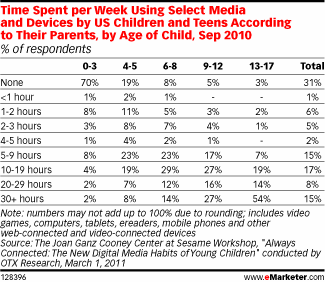
The digital toys and media bring
significant challenges to early childhood education. Children today are
literally surrounded by digital technology. A recent survey revealed that 70%
of 4-6 year-olds in the United States had used a computer, averaging more than
one hour per day. Young children also spend considerable time playing with
computerized toys (Johnson & Christie, 2009)
Many scholars have described the present
generation as the iGeneration. The virtual and electronic world has such
impacts on today’s iKids. Educators and parents are faced with an unprecedented
new educational challenge. We must wake up to the cold reality that our
children are now spending an average of seven hours and 38 minutes per day, 53
hours per week indoors (Kaiser Family Foundation), using electronic media such
as television, iphone, ipod, and playing
video games. Outdoor time, especially
time in natural surroundings has literally demised. The “Indoor childhood”
phenomena have many negative impacts on our children’s long term physical,
emotional, and educational development.
Children have less opportunity spend in
natural places than we did two decades ago. We noted that time outside school
was increasingly filled with adult-organized activities and indoor screen time.
Children no longer had the space or opportunity to organize their own play or
discover their own secret spaces. In Last
Child in the Woods, author Richard Louv (2005) coined the term
Nature-Deficit Disorder to describe the human costs of alienation from nature,
among them: diminished use of the senses, attention difficulties, and higher
rates of physical and emotional illness (p. 36).
The
Vital Importance of Open-Ended Creative Play and Constructive Play
Open-ended creative play is disappearing
from children’s lives because of unsafe neighborhoods that keep children
indoors; parents’ fear of “stranger danger,” injuries and allergies; the
seductiveness of electronic games and entertainment; an increase in teacher-led
instruction in preschool that is pushing child-initiated learning and
exploration out of the classroom; and children’s diminishing access to woods,
fields, parks, and other natural wild play spaces.
Constructive play is learning outdoors.
This kind of play teaches children important skills, develops critical
cognitive concepts, and is their favorite kind of play on the outside
playground, however, this kind of play is often least available for children
for a variety of reasons.
Discussions-
How Can This Situation Be Rectified?
One partial solution is to give children
more time outdoors to play and learn. It is necessary for a child to be healthy
and creative, to care about nature and animals, ultimately, to obtain a good
education and a happy childhood.
Children need natural space and natural
materials, and most importantly, unrushed time tin nature to be healthy people.
Nature and outdoors offer concrete and authentic learning experiences. Nature
education advocate, author Richard Louv says, “We should Leave No Child Inside and
not No Child Left Behind" (Louv, 2005).
Children are naturally curious, born
with a sense of wonder and discovery, and passionate about their surroundings.
Edward. O. Wilson (1984), the noteworthy
Pulitzer Prize winning evolutionary biologist at Harvard University proposed
the Biophilia Hypothesis in 1979 (Wilson, 1995), which argues that there is a
fundamental, genetically-based human need to connect with other forms of life
(Wilson, 1995. p.360). He defines Biophilia as "The urge to affiliate with
other forms of life". Wilson’s Biophilia theory emphasized the desire for
humans to interact with nature and the positive impacts of such interacts and
connections.
The
Values of Nature and Outdoor Play
Researches show that children who play
outside are more physically active, more creative in their play, less
aggressive and show better concentration (Burdette and Whitaker, 2005; Ginsburg
et al., 2007). Young children are naturally active. Outdoor and nature play is
the essential work of childhood. In nature and outdoor creative play, children
use all their senses, learn to socialize and negotiate with peers,
and learn to appreciate life and environment, learning to love
the earth and each other, and have their private life in nature with freedom. The
values of play are universally accepted within the world of early childhood
education. Play allows children to
develop a sense of belonging, improves their interpersonal skills, and develops
their learning capabilities. Play can help to prevent obesity, can increase
resilience, and can help children to feel more confident and independent. Play
has particular value to children at times of stress or changes in their lives.
Howard
Gardner -Naturalist Intelligence
Howard Gardner reframed a new kind of
intelligence called Naturalist Intelligence in his book Intelligence Reframed, Multiple Intelligences for the 21th Century.
Naturalist Intelligence describes the children who have special capability and
perception about natural environment. The characteristics of a child who may
have a strong naturalist intelligence are
have keen sensory skills, including sight, sound, smell, taste, and
touch; Readily use heightened sensory skills to notice and categories things
from the natural world; Like to be outside or like outside activities like
gardening, nature walks, or field trips geared toward observing nature or
natural phenomena; Easily notice patterns from their surroundings like
differences similarities and anomalies; Are interested in and care about plants
and animals; Notice things in the environment others often notices (Gardner,
2000). Children are intelligent in many ways. We need to encourage a diverse
intelligence among young children. Naturalist
Intelligence needs to be identified, recognized, valued, encouraged, and nurtured.
Children benefit profoundly from regular
interactions with nature and play outside of their house. Children need nature.
Nature provides resource to children, the confidence of the children raised
with nature. Nature offers concrete and authentic learning experiences. Nature
can provoke a child’s curiosity and desire to investigate and to develop a
diverse relationship with earth, natural world, animals, creatures, plants,
peers, adults. Nature is a place for developing community and a place for
invite and uncovers diversity.
In the book of Nature Principle Richard Louv states that “The future will belong
to the nature-smart—those individuals, families, businesses, and political
leaders who develop a deeper understanding of the transformative power of the
natural world and who balance the virtual with the real. The more high-tech we
become, the more nature we need” (Louv, 2012)
Conclusions
and Recommendations- Planting
and Growing a Green Generation
There is an urgent need for letting the
children play outdoors and connect with the natural world. Children have an innate biological tendency to
connect with the Mother Nature. We need a
balance to our academically and technologically demanding world. We are responsible for giving the children a
happy, healthy, and playful childhood.
Nature and outdoors are spaces can be
changed and used in an imaginative way and places for doing, thinking, wondering,
discovering, feeling, and being. It is a place where teachers can response to
child-initiated interaction and build on children’s interests and therefore
rich learning can take place. In recent years, a growing influence of the
Italian Reggio Emilia early childhood educational approach implying an
increasing interest in space and architecture in early childhood settings.
Young children are active learners. Their
best learning occurs with hands-on, interactive play and discovery. They must
be given developmentally appropriate opportunities to learn about the natural
world (White & Stoecklin, 2008). Therefore, helping and supporting children
to develop a loving relationship the natural world is the priority. Provide a
nature playground and encourage outdoor play are vital to young children's
healthy development. Nature explore classroom projects, incorporating natural
elements and using natural materials and loose parts, planting and growing a
garden, having recess, greening the school ground, learning about nature and outdoors, and finding time to walk
to school are ways to help children reconnect with nature. We need to provide
and create a nature playground and outdoor space for children’s cognitive
engagement as well as their physical and social development.
Together, we bring a true happy, healthy,
and joyful childhood to young children. Let the children play, let them play in
nature and outdoors, let them be child, let them be little, and let them run,
let them be free, and let them wonder and discover, and let them fly…
References
Gardner,
H. (2000). Intelligence Reframed, Multiple Intelligences for the 21th Century.
Basic Books.
Goodenough,
E. (2003). Secret Spaces of Childhood.
University of Michigan Press.
Louv,
R. (2005). Last Child in the Woods. New
York, NY: Algonquin.
Louv, R. (2011). Nature Principle. Algonquin Books.
Johnson,
James, & James F. Christie. (2009). Play and Digital Media. Computer in the Schools,
(26), 284-289. Taylor & Francis Group, LLC.
White,
R., & Stoeckin, V. (2008). Nurturing Children’s Biophilia: Developmentally Appropriate
Environmental Education for Young Children. White Hutchinson Leisure & Learning Group.
Wilson,
E. O. (1984). Biophilia. Harvard
University Press.
Satistics Retrived May 18, 2012, from Frankwbaker website, http://www.frankwbaker.com/mediause.htm