1.
Activity name: Fairy House
Brief description:
· Rocks, clay, water, pine branches, tree branches, leaves, feathers, dirt, shells, pine cones, acorns, flowers, river rocks, sticks, grass, and fruit.
· Ask the children to collect nature objects.
· Design the fairy house.
· Build a fairy house.
· Create fairy tales.
Objectives: As a result of this activity, the children will:
· Learn to collect and gathering objects and information.
· Develop a clear understanding of fairy tales.
· Develop designing skills.
· Gain confident in doing science experiments.
· Engage in a project with peers or with a small group.
· Learn to work in team and help each other.
· Grow aesthetic awareness.
2 2.
Activity name: Leaf printing and painting
Brief description: · A group activity that involve collaborations and team work.
· Children collect pumpkin leaves from the school garden.
· Acrylic paint, brushes, large canvas, and glitters.
· Children chose their favorite colors to paint on the leaf and then press on the canvas.
· Final step is using glitters to decorate the leaves
Objectives: As a result of this activity, the children will:
• Grow appreciation about nature and plants, especially Pumpkin leaves.
• Collect, describe, natural items in the school garden.
• Ask questions about nature and comments on observations in their environment.
• Build friendship and collaborate with peers.
• Nurture creativity and raise aesthetic awareness.
3.
Brief descriptions:
3.
Activity name: Shadow Tag
Brief description:
·
Large Group
activity.
·
On a sunny
day, choose one person to be “it”.
·
Everyone else
makes a big circle around her.
·
When she says
“go”, you run! And don’t let her stomp on your shadow.
·
If you get
caught, you are the next stomper.
Objectives: As a result of this activity, the children will:
·
Learn to
follow game rules and directions.
·
Learn to
collaborate with team.
·
Participant
actively as a member of the classroom community.
·
Develop gross
motor skills.
·
Analyze how
shadow change as the direction of the light changes.
·
Making
shadows.
4.
Activity name: Where is Light Coming
From? (Making a list of the source of the light) Hunting for Light!
Brief description:
·
Note pads,
pencils, crayons, poster board, and clipboards.
·
Invite the
children finding out the source of the light.
·
Identify the
sources of the light.
·
Discussion,
circle activity, and then goes out to playground and hunting for light.
·
Discussion and
making a list.
·
The sun, stars,
Smartboard, overhead projector, light table, lamps, flashlights, lanterns, milky way, starry light, lightening, northern
light, lava and volcano, firefly, candles, and light bulbs.
·
Study about
the list.
·
Display the
list.
Objectives: As a result of this activity, the children will:
·
Participant
actively as a member of the classroom community.
·
Develop
observation, listening, and speaking skills.
·
Discover the
source of the light.
·
Analyze how
the direction of the light changes.
·
Ask questions
about and comments on observations and experimentation.
·
Raise
awareness about the natural phenomena.
5.
Activity name: Living and Non-Living Things Chart
·
Children identify
living thing in the environment.
·
Children
collect Living things or pictures in school and at . home.
·
Children
classify and sort Living and Non-Living
Things
·
Make a Living
and Non-Living Things Chart
Objectives: As a result of this activity, the children will:
·
Understand the
differences between living and non-living things.
·
Be able to
identify some of the living and nonliving things.
·
Collects and
describes information.
·
Compares and
contrasts objects.
·
Participates
in simple investigations to test observations.
6.
6.
Activity name:Make Your Own Rainbow
Brief description:
·
Children fill
a bowl of water and put it in front of a classroom sunny window.
·
Place a mirror
in the bowl with its shinny side facing the sunlight.
·
Lean the
mirror against one side of the bowl so it is standing up.
·
Have another
student hold a piece of white paper outside the bowl across from the mirror.
·
The water in
the bowl will separate the sunlight into colors and the mirror will reflect it.
·
A small
rainbow will spread out on the white paper.
Objectives: As a result of this activity, the children will:
Objectives: As a result of this activity, the children will:
·
Gain deeper
understands about the concept of light, reflections, and colors.
·
Gain
confidents in doing science experiments.
·
Engages in a
scientific experiment with a peer or with a small group.
·
Learn to work
in team and help each other.
·
Learn the
names of the color in a rainbow
·
Learn what
makes a rainbow.
7.
· Rocks, pebbles, baskets, and small bags.
· Ask the children to collect rocks and pebbles.
· Work in small group.
· Share discovery and collection.
· Learn the shapes of the rocks.
· Learn the color of the rocks.
· Observe closely. Does it look like an animal?
· Rock show-display.
Objectives: As a result of this activity, the children will:
8.
Activity name: Nature Walk and Explorations
Brief description:
· Observe nature and animal behaviors.
· Taking pictures.
· Collecting nature objects.
· Collecting fall leaves.
· Making leave collages.
· Cleaning the environment (picking up trashes) while walking.
· Share discoveries in circle time.
· Circle discussions about the nature walk.
Objectives: As a result of this activity, the children will:
• Recall changes in nature, weather, and climate. (What the weather like during fall season?)
• Know the names of the four seasons (What are the names of the four seasons?)
• Understand and using terms. (hard, soft, dry, wet, heavy, and light)
• Grow appreciation of nature and the environment.
9.
Brief description:
• Clay, water, pine branches, water color, or food coloring, baking soda, vinegar, dish detergent, tray or sensory tub.
• Using clay to build a volcano around a cup.
• Don’t cover the hole or drop the clay inside.
• Add 3 tablespoon of baking soda.
• Add 6 drops of food coloring or watercolor.
• Add 2 tablespoon detergent into the clay volcano.
• Pour in 1 cup of vinegar into the bottle.
• Watch out!
• Know the parts of a volcano
• Learn types of volcano
• Know Shapes of volcanoes
• Gain confidents in doing science experiments.
• Engage in a scientific experiment with a peer or with a small group.
• Learn to work in team and help each other.
• Know what a volcanologist does.
7.
Activity name: Treasure Hunting-Rocks!
· Rocks, pebbles, baskets, and small bags.
· Ask the children to collect rocks and pebbles.
· Work in small group.
· Share discovery and collection.
· Learn the shapes of the rocks.
· Learn the color of the rocks.
· Observe closely. Does it look like an animal?
· Rock show-display.
Objectives: As a result of this activity, the children will:
·
Learn to
collect and gathering objects and information in nature.
·
Develop a
clear understanding about shapes and colors.
·
Develop math skills.
·
Build
friendship in working with a small group of peers.
·
Engage in a project
with peers or with a small group.
·
Grow aesthetic
awareness and a sense of wonder.
·
Learn to
appreciate the beauty of the nature.
8.
Activity name: Nature Walk and Explorations
· Observe nature and animal behaviors.
· Taking pictures.
· Collecting nature objects.
· Collecting fall leaves.
· Making leave collages.
· Cleaning the environment (picking up trashes) while walking.
· Share discoveries in circle time.
· Circle discussions about the nature walk.
Objectives: As a result of this activity, the children will:
• Recall changes in nature, weather, and climate. (What the weather like during fall season?)
• Know the names of the four seasons (What are the names of the four seasons?)
• Understand and using terms. (hard, soft, dry, wet, heavy, and light)
• Grow appreciation of nature and the environment.
9.
Activity name: volcano Eruption
Brief description:
• Clay, water, pine branches, water color, or food coloring, baking soda, vinegar, dish detergent, tray or sensory tub.
• Using clay to build a volcano around a cup.
• Don’t cover the hole or drop the clay inside.
• Add 3 tablespoon of baking soda.
• Add 6 drops of food coloring or watercolor.
• Add 2 tablespoon detergent into the clay volcano.
• Pour in 1 cup of vinegar into the bottle.
• Watch out!
Objectives: As a result of this activity, the children will:
• Learn types of volcano
• Know Shapes of volcanoes
• Gain confidents in doing science experiments.
• Engage in a scientific experiment with a peer or with a small group.
• Learn to work in team and help each other.
• Know what a volcanologist does.
10.
Activity name: Who is Eating Our Tulip Bulbs?
Brief description:
• The school garden’s tulip bulbs have been eaten by a mysterious monster.
• The children want to find out who is eating our tulip bulbs.
• Research to determine who has eaten our tulip bulbs.
• Collaborate with pre-k to find out who is the thief?
• Determine how to catch the thief.
• Ask science teacher to help us.
• Further research on how to protect our bulbs.
• Create an owl to protect the tulip bulbs.
• Learn to use research tools.
• Grow appreciation of nature and the environment.
• Learn to work with older children and collaborate with them.
• Practice problem-solving skills and finding solutions.
Websites about Nature Education and Outdoor Play:
King County Parks & Recreation: http://www.kingcounty.gov/recreation/parks.aspx
Seattle Aquarium: http://www.seattleaquarium.org/
Pacific Science Center: http://www.pacificsciencecenter.org/:
Books about Nature Education and Outdoor Play:
The Potential of a Puddle by Claire Warden
Nature Kindergartens: An Exploration on Naturalistic Learning within Nature Kindergartens and Forest Schools by Claire Warden
'THE RIGHT TO BE ''ME''' by Claire Warden
Nurture Through Nature by Claire Warden
Last Child in the Woods by Richard Louv.
Nature Principle by Richard Louv.
Biophilia by Edward. O. Wilson
Beyond Ecophobia: Reclaiming the Heart in Nature Education by David Sobel
The Geography of Childhood by Gary Paul Nabhan & Stephen Trimble.
Growth Through Nature: A Preschool Program for Children with Disabilities by Molen, Chambers, Wichrowski, Fried.
The Inclusive Learning Center Book for Preschool children with special needs by Christy Isbell and Rebecca Isbell.
Nature and Young children; encouraging creative play and learning in natural environment by Ruth Wilson.
The great outdoors; restoring children’s right to play outside. By Mary S. Rivkin.
Play: How It Shapes the Brain, Opens the Imagination, and Invigorates the Soul by Stuart Brown
The Power of Play: How Spontaneous, Imaginative Activities Lead to Happier, Healthier Children by David Elkind
The Case for Make Believe: Saving Play in a Commercialized World by Susan Linn
A Child’s Work: The Importance of Fantasy Play by Vivian Gussin Paley
The House of Make-Believe: Children’s Play and the Developing Imagination by Dorothy and Jerome Singer
The Playwork Primer by Penny Wilson
249-259.
Louv, R. Richard Louv's Website, http://richardlouv.com/
Molen, Chambers, Wichrowski, & Fried. (1999). Growth Through Nature: A Preschool Program for
Children with Disabilities. Sagapress, Incorporated.
Nabhan, P. & Trimble, S. (1995) The Geography of Childhood. Beacon
Press.
Riojas-Cortez, M. (2001). Preschoolers' Funds of Knowledge Displayed
through Socialdramatic Play Episodes in a Bilingual Classroom.
Early Childhood Journal. 29 (1).
Samuelsson, I. & Carlsson, M. (2008). The Playing Learning Child:
Towards a Pedagogy of Early Childhood. Scandinavian Journal of
Education Research. 52 (6), 623-641.
Sobel, D. (1999). Beyond Ecophobia: Reclaiming the Heart in Nature
Education. Orion Society.
White, R., & Stoeckin, V. (2008). Nurturing Children’s Biophilia: Developmentally
Appropriate
Naturalistic Learning within Nature Kindergartens and Forest
Schools. Mindstretchers.
Warden, C. (2007). The Potential of a Puddle. Mindstretchers.
Warden, C. (2007) Nurture Through Nature.Mindstretchers.
Waters, J. & Maynard, T. (2010). What's so Interesting Outside? A Study
of Child-Initiated Interaction with Teachers in the Natural
Outdoor Environment. European Early Childhoods Education
Cognition and Self-Regulation: What Exactly are Children
Learning When They Learn Through Play.Educational & Child
Psychology. 26 (2).
Youngquist, J. & Pataray-Ching, J. (2004). Revising "Play": Analyzing and
articulating Acts of Inquiry. Early Childhood Education
Journal. 31 (3).
Richard Louv talks about Nature-Deficit Disorder




YouTube video: http://www.youtube.com/watch?v=UUKbxbmpcwU
Types of Play
Brief description:
• The school garden’s tulip bulbs have been eaten by a mysterious monster.
• The children want to find out who is eating our tulip bulbs.
• Research to determine who has eaten our tulip bulbs.
• Collaborate with pre-k to find out who is the thief?
• Determine how to catch the thief.
• Ask science teacher to help us.
• Further research on how to protect our bulbs.
• Create an owl to protect the tulip bulbs.
Objectives: As a result of this activity, the children will:
• Learn to use research tools.
• Grow appreciation of nature and the environment.
• Learn to work with older children and collaborate with them.
• Practice problem-solving skills and finding solutions.
http://www.nwf.org/~/media/PDFs/Be%20Out%20There/Back%20to%20School%20full%20report.ashx Statistics about the Media and Children.
http://www.frankwbaker.com/mediause.htm Statistics about play and children.
http://www.naturerocks.org/ Leave no child inside.
http://www.orionmagazine.org/index.php/articles/article/240/ Richard Louv quotes and books.
www.greatplantpicks.org. about outdoor and plants
www.birdcornell.com. about nature and birds and
http://resources.spaces3.com/c518d93d-d91c-4358-ae5e-b09d493af3f4.pdf Early childhood guidelines about nature education.
http://www.arborday.org/explore/index.cfmTrakingID=143&gclid=CPzovJmRo7ACFQ5rhwodLBFsXQ about nature education.
http://www.warmbeach.com/index.php/programs/outdoor-education?gclid=CMOfyMmRo7ACFaUZQgodGzhAXA Outdoor education
http://www.everykidoutsidenwoh.org/resources-for-you.html No child leaves inside. http://www.acornnaturalists.com/ acorn naturalist.materials about nature.
http://www.insectlore.com/ website about insects.
http://wdfw.wa.gov/wildwatch/eaglecam/ Washington department of Fish and Wildlife.
http://www.usgs.gov/ U.S. Geology Survey.
Nature in My Neighborhood:
Seattle Park & Recreation
Environmental Learning Center : http://www.seattle.gov/parks/parkspaces/CarkeekPark/elc.htmKing County Parks & Recreation: http://www.kingcounty.gov/recreation/parks.aspx
Seattle Aquarium: http://www.seattleaquarium.org/
Pacific Science Center: http://www.pacificsciencecenter.org/:
Books about Nature Education and Outdoor Play:
The Potential of a Puddle by Claire Warden
Nature Kindergartens: An Exploration on Naturalistic Learning within Nature Kindergartens and Forest Schools by Claire Warden
'THE RIGHT TO BE ''ME''' by Claire Warden
Nurture Through Nature by Claire Warden
Last Child in the Woods by Richard Louv.
Nature Principle by Richard Louv.
Biophilia by Edward. O. Wilson
Beyond Ecophobia: Reclaiming the Heart in Nature Education by David Sobel
The Geography of Childhood by Gary Paul Nabhan & Stephen Trimble.
Growth Through Nature: A Preschool Program for Children with Disabilities by Molen, Chambers, Wichrowski, Fried.
The Inclusive Learning Center Book for Preschool children with special needs by Christy Isbell and Rebecca Isbell.
Nature and Young children; encouraging creative play and learning in natural environment by Ruth Wilson.
The great outdoors; restoring children’s right to play outside. By Mary S. Rivkin.
Play: How It Shapes the Brain, Opens the Imagination, and Invigorates the Soul by Stuart Brown
The Power of Play: How Spontaneous, Imaginative Activities Lead to Happier, Healthier Children by David Elkind
The Case for Make Believe: Saving Play in a Commercialized World by Susan Linn
A Child’s Work: The Importance of Fantasy Play by Vivian Gussin Paley
The House of Make-Believe: Children’s Play and the Developing Imagination by Dorothy and Jerome Singer
The Playwork Primer by Penny Wilson
References
Cheng, M. & Johnson, J. (2010). Research on Children's Play: Analysis of Developmental
and Education Journals from 2005-2007. Early Childhood Education Journal. 37, 249-259.
Gardner, H. (2000). Intelligence Reframed, Multiple Intelligences for the 21th Century.
Basic Books.
Gardner, H. Project Zero. Harvard university Website, http://www.pz.harvard.edu/pis/hg.htm
Goodenough, E. (2003). Secret Spaces of Childhood. University of Michigan Press.
Louv, R. (2005). Last Child in the Woods. New York, NY: Algonquin.
Louv, R. (2011). Nature Principle. Algonquin Books. Louv, R. Richard Louv's Website, http://richardlouv.com/
Molen, Chambers, Wichrowski, & Fried. (1999). Growth Through Nature: A Preschool Program for
Children with Disabilities. Sagapress, Incorporated.
Johnson, James, & James F. Christie. (2009). Play and Digital Media. Computer in the
Schools, (26), 284-289. Taylor & Francis Group, LLC.Press.
Riojas-Cortez, M. (2001). Preschoolers' Funds of Knowledge Displayed
through Socialdramatic Play Episodes in a Bilingual Classroom.
Early Childhood Journal. 29 (1).
Samuelsson, I. & Carlsson, M. (2008). The Playing Learning Child:
Towards a Pedagogy of Early Childhood. Scandinavian Journal of
Education Research. 52 (6), 623-641.
Sobel, D. (1999). Beyond Ecophobia: Reclaiming the Heart in Nature
Education. Orion Society.
White, R., & Stoeckin, V. (2008). Nurturing Children’s Biophilia: Developmentally
Appropriate
Wilson, E. O. (1984). Biophilia. Harvard University Press.
Warden, C. (2010). Nature Kindergartens: An Exploration on Naturalistic Learning within Nature Kindergartens and Forest
Schools. Mindstretchers.
Warden, C. (2007). The Potential of a Puddle. Mindstretchers.
Warden, C. (2007) Nurture Through Nature.Mindstretchers.
Waters, J. & Maynard, T. (2010). What's so Interesting Outside? A Study
of Child-Initiated Interaction with Teachers in the Natural
Outdoor Environment. European Early Childhoods Education
Research Journal. 18 (4), 473-483.
Whitebread, D. Coltman, P. Jameson, H. & Lander, R. (2009). Play, Cognition and Self-Regulation: What Exactly are Children
Learning When They Learn Through Play.Educational & Child
Psychology. 26 (2).
Youngquist, J. & Pataray-Ching, J. (2004). Revising "Play": Analyzing and
articulating Acts of Inquiry. Early Childhood Education
Journal. 31 (3).
YouTube Video about Richard Louv's Nature Principle.
Song-Let them be little by Billy Dean
Richard Louv talks about Nature-Deficit Disorder
YouTube video: http://www.youtube.com/watch?v=1e6_cY3-J3o
The Nature Alphabet
YouTube video: http://www.youtube.com/watch?v=mjg6jWwi9MI
Richard Louv's book-Last Child in the Woods. He coined the term, Nature-Deficit Disorder. This book has brought many public, parents and educators' attention on the children's disconnection with nature and its impacts on the healthy development of present generation.
Below is a great resource for nature education ideas and lesson plans.

Children and Nature Network
The Children & Nature Network is leading a movement to connect all children, their families and communities to nature through innovative ideas, evidence-based resources and tools, broad-based collaboration and support of grassroots leadership.
Children and Nature Network. (n.d.). Retrieved May 30, 2012, from Children and Nature Network website: http://www.childrenandnature.org/
The National Environmental Education Foundation website http://www.neefusa.org/health/children_nature.htm
National Environmental Education Week (EE Week), the nation's largest environmental education event held each year the week before Earth Day, inspires environmental learning and stewardship among K-12 students. EE Week connects educators with environmental resources to promote K-12 students' understanding of the environment.
The National Environmental Education Foundation. (n.d.). Retrieved May 30, 2012, from The National Environmental Education Foundation website: http://www.neefusa.org/health/children_nature.htm
Images from My School's Playground, Children's Garden and Rooftop Garden.


I found some interesting facts about children's outdoor play time.
Fast Facts About Outdoor Time and Children
- Children are spending half as much time outdoors as they did 20 years ago. (Juster et al 2004); (Burdette & Whitaker 2005); (Kuo & Sullivan 2001)
- Today, kids 8-18 years old devote an average of 7 hours and 38 minutes using entertainment media in a typical day (more than 53 hours a week). (Kaiser Family Foundation)
- In a typical week, only 6% of children ages 9-13 play outside on their own. (Children & Nature Network, 2008)
- Children who play outside are more physically active, more creative in their play, less aggressive and show better concentration. (Burdette and Whitaker, 2005; Ginsburg et al., 2007)
- Sixty minutes of daily unstructured free play is essential to children’s physical and mental health. (American Academy of Pediatrics, 2008)
- The most direct route to caring for the environment as an adult is participating in “wild nature activities” before the age of 11. (Wells and Lekies, 2006)
Source: National Wildlife Foundation:
http://www.nwf.org/Get-Outside/Be-Out-There/Why-Be-Out-There.aspx
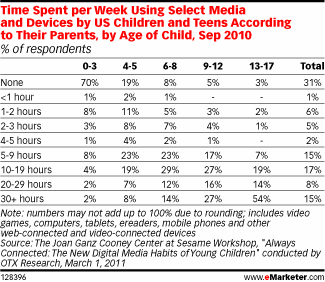
I found these charts and tables about the children using electronic devices.
Source: http://www.frankwbaker.com/mediause.htm
Song- Mother Earth - Children Love to Sing & Dance Kids Song with Lyrics
YouTube video: http://www.youtube.com/watch?v=UUKbxbmpcwU
Types of Play
YouTube video: http://www.youtube.com/watch?v=uSUdGqK6ohM

Wen,
ReplyDeleteWhat a great list of lessons for children, they are very easy to do and help students connect to their environment! I also like that many of them incorporate art which encourages creative thinking and student interest.
Thanks for posting these!